The Foundational Architecture of Watercraft
Every vessel afloat shares a universal structural logic, whether it is an eighteen-foot aluminum fishing skiff or an ocean-going yacht. Understanding each fundamental part of a boat allows you to communicate clearly with mechanics, evaluate wear and tear, and handle unexpected issues safely while underway. Marine terminology can initially seem like a foreign dialect, but every traditional term exists for functional clarity rather than decoration. Nautical language eliminates ambiguity when immediate orientation is required in rough conditions.
Instead of using casual directions like left or right, maritime conventions use port and starboard to denote relative position. Port refers strictly to the left side of the vessel when facing toward the front, while starboard indicates the right side. These definitions remain absolute regardless of which way you stand on the deck. Similarly, toward the front is called forward or fore, while moving toward the back is moving aft or abaft, preventing confusion during close-quarters maneuvers.
When you begin browsing boats for sale in stock, you will notice that every listing emphasizes hull geometry, interior layouts, and propulsion styles. A standard vessel divides broadly into two major realms: the hull, which provides flotation and houses structural framing, and the topsides or deck, which supports passenger seating and navigation gear. Understanding how these sections interface makes identifying potential mechanical strain or water intrusion much simpler.
The Forward Hull and the Anatomy of the Bow
The very front of any vessel is universally identified as the bow, serving as the leading edge that cuts through swells and directs spray away from the deck. The forwardmost structural point where the two hull halves join together is known as the stem, an area designed to absorb significant hydrodynamic pressure. On larger vessels, people often refer to this section as the ships bow, and its shape largely dictates whether a boat rides smoothly or slams violently into oncoming chop.

Below the deckline at the bow lies the entry, which describes the narrowness and sharpness of the forward hull angles. A fine, sharp entry slices cleanly through chop, offering a softer ride at cruising speeds, whereas a blunt, rounded bow provides greater interior cabin volume and lift in following seas. Above the waterline, flared bows extend outward, throwing water away from passengers to keep the cockpit dry during wet crossings.
On the foredeck itself, you will find vital equipment used for docking and anchoring. The anchor locker is commonly molded directly into the apex of the bow to store ground tackle, chain, and rode without cluttering walking surfaces. Bow eyes, bow rails, and forward cleats are bolted securely through backing plates in this area, designed to handle immense loads when anchored in moving currents or tied to moorings.
The Aft Section and Transom Mechanics
Moving toward the rear brings you to the stern of the boat, the critical zone responsible for buoyancy, propulsion mounting, and water exit. The flat or slightly curved vertical surface that caps off the hull at the rear is called the transom. On outboard-powered hulls, the transom carries the entire static and dynamic weight of the engine, transferring hundreds of pounds of thrust into forward momentum through heavy structural framing.
The shape and deadrise of the hull near the stern dictate how a vessel planes, handles wake, and maintains stability at rest. Flatter hulls near the aft corners, known as the chines, provide initial stability and quick planing capability, while deeper V-shaped bottoms offer softer re-entry at high speeds. The lower corner where the bottom of the hull meets the side is the chine, which plays a major role in how the aft section grips the water in tight turns.
Modern stern arrangements often integrate extended swim platforms, boarding ladders, and engine brackets that project past the structural hull boundary. When evaluating inspecting used boats on the lot, inspecting the stern and transom for stress cracks, flex, or soft wood cores is paramount. Water intrusion around improperly sealed motor bolts or transducer screws can silently rot inner plywood transom cores over several seasons.
Hull Geometry: Keel, Chine, and Waterline
The backbone of any vessel is its keel, running longitudinally along the very center bottom of the hull from the bow to the stern. On traditional wooden or metal vessels, the keel is a distinct external timber or beam providing directional stability and grounding protection. On modern fiberglass hulls, the keel is typically integrated into the central V-bottom molding, reinforced with dense layers of fiberglass roving to handle grounding loads.
Between the keel and the upper edges of the hull are lifting strakes and spray rails. Lifting strakes run parallel to the keel and act like tiny underwater wings, generating hydrodynamic lift as speed increases to reduce wetted surface area. Spray rails, located along the upper hull sides, deflect rising sheets of water downward, which helps maintain a dry deck and preserves forward visibility in stiff crosswinds.
The true waterline defines where the boat rests in the water under its standard operating weight, separating the bottom paint from the topsides. The distance between the waterline and the lowest underwater projection is known as the draft, which tells you how much water depth you need to navigate safely. The distance from the waterline up to the lowest point of the deck is the freeboard, an essential safety measurement for preventing swamping.
The Helm Station: Controls, Consoles, and Driver Dynamics
The control center of any boat is the helm station, which houses the primary navigational instruments, engine gauges, throttle levers, and steering hardware. Whether situated inside an enclosed pilothouse or integrated into an open center console, the helm represents the operational bridge of the vessel. The helm seat is positioned to provide an unobstructed view of the surrounding horizon and forward running lane.
Central to this station is the boat steering wheel, mounted on a rotary helm shaft or hydraulic pump hub directly in front of the operator. Often referred to simply as the ship driving wheel or the ship helm wheel in maritime history, modern steering controls are finely calibrated devices engineered to withstand corrosive salt air. Unlike an automotive steering setup, marine wheels operate against water resistance and do not typically self-center after a turn is completed.
Beside the steering apparatus, the helm incorporates the binnacle, commonly known as the throttle and shift control. This single-lever or twin-lever assembly controls transmission engagement and engine revolutions per minute. Adjacent switches govern essential electrical systems, including bilge pumps, running lights, livewell aerators, and marine VHF radios, putting critical safety systems within arm's reach of the driver.
Evolution of the Ship Steering Wheel
Before the advent of mechanical steering wheels, large vessels were steered using a direct lever attached to the top of the rudder stock, known as a tiller. As ships grew larger during the Age of Sail, the hydrodynamic forces on the rudder became too severe for hand-held tillers, prompting the development of the traditional spoked wheel of the ship in the early eighteenth century. This mechanical innovation used drums and ropes to multiply human muscle power.
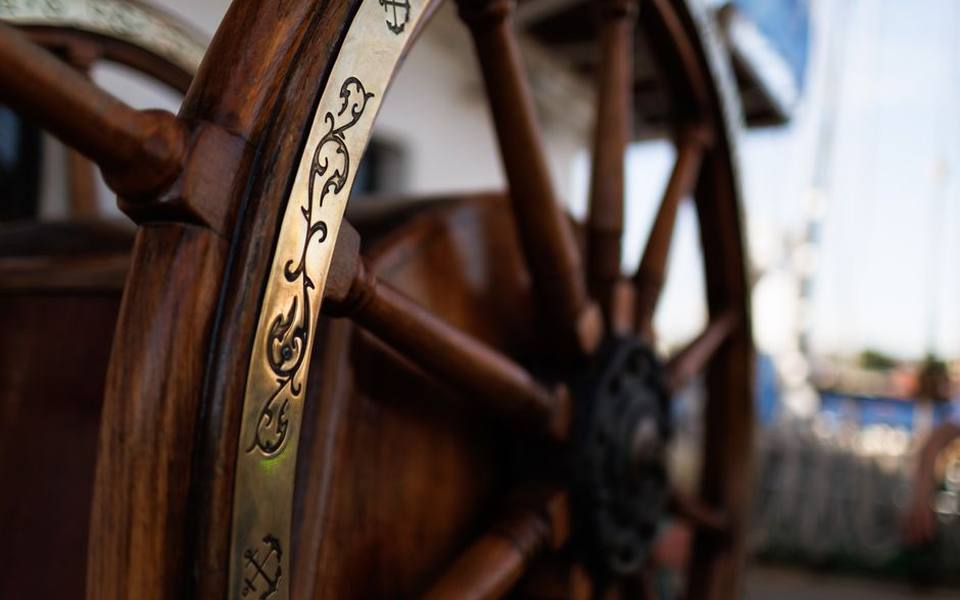
Pop culture often depicts this design as a pirate steering wheel, characterized by heavy mahogany construction, eight or ten projecting handles, and a central bronze hub. The protruding handles, or spokes, provided necessary leverage for multiple deckhands to wrestle the rudder during heavy ocean gales. One spoke was typically marked with a carved notch or brass inlay, known as the king spoke, allowing the helmsman to feel when the rudder was centered even in complete darkness.
While traditional spoked designs remain popular on tall ships and vintage cruisers, modern runabouts and center consoles use compact stainless steel, polyurethane, or carbon-fiber wheels. Today's ship steering wheel variants feature ergonomic grips, internal tilt mechanisms, and turning knobs that allow quick one-handed maneuvering around docks. Despite the change in materials, the core task to steer ship wheel assemblies smoothly remains identical: translating rotational movement into directional thrust below the hull.
Underneath the Hull: The Mechanics of the Rudder
Turning a boat requires redirecting the water flow passing underneath the hull, a task historically assigned to the rudder of a boat. On inboard vessels, the rudder consists of a flat, hydrodynamic blade suspended vertically behind the propeller. When the operator turns the helm, the rudder rotates on a vertical axis, creating asymmetrical pressure that forces the stern to swing in the opposite direction, yawing the bow toward the desired course.
A typical rudder system relies on several critical mechanical parts working beneath the deck plates. The rudder stock is the heavy vertical shaft passing up through the hull bottom via a specialized, watertight fitting called a stuffing box or rudder port. Inside the hull, a metal arm called the tiller arm attaches to the top of the stock, where it connects directly to mechanical steering cables or hydraulic ram cylinders.
On boats equipped with outboard motors or sterndrives, there is usually no separate underwater rudder blade at all. Instead, the entire lower gearcase pivots on an external gimbal ring or swivel bracket. The motor's lower skeg—a vertical metal fin beneath the propeller—acts as a secondary rudder blade, stabilizing tracking at speed and providing directional control even when drifting in neutral.
Steering Linkages: Mechanical Cables and Hydraulic Systems
Connecting the steering wheel at the helm to the steering mechanism at the stern involves either mechanical cable linkages, closed hydraulic loops, or digital drive-by-wire servos. Entry-level and smaller boats commonly use rotary mechanical cable systems, where a flexible steel core cable slides inside a protective conduit, pushed and pulled by a geared rack behind the dash. Over time, these cables can stiffen due to corrosion, requiring regular lubrication or full replacement from a dealer with a parts department.
Higher-horsepower outboards and larger twin-engine vessels typically rely on hydraulic steering systems for smoother, safer operation. In a hydraulic configuration, turning the helm wheel turns a miniature axial piston pump that forces hydraulic fluid through pressurized hoses down to a double-acting cylinder mounted on the engine or rudder. This design eliminates steering torque feedback, preventing the wheel from wrenching violently out of your hands when hitting wakes at cruising speeds.
The latest marine vessels increasingly utilize electronic power-assisted steering and digital joystick maneuvering. In these setups, sensors behind the wheel translate rotational input into electronic data signals sent directly to an onboard computer. Electric actuators then pivot the motors independently, allowing complex movements such as walking a boat sideways toward a fuel dock using subtle inputs from a small joystick.
Deck Hardware, Gunwales, and Exterior Fittings
The perimeter of the deck is bounded by the gunwale (pronounced gun-nel), which is the upper edge where the hull sides meet the deck cap. The gunwale takes considerable punishment during docking and rafting, which is why builders wrap it in a heavy-duty rub rail made of flexible vinyl, rubber, or stainless steel. Running along the gunwales, you will find rod holders, hawse pipes, and recessed handrails designed to improve safety on board.
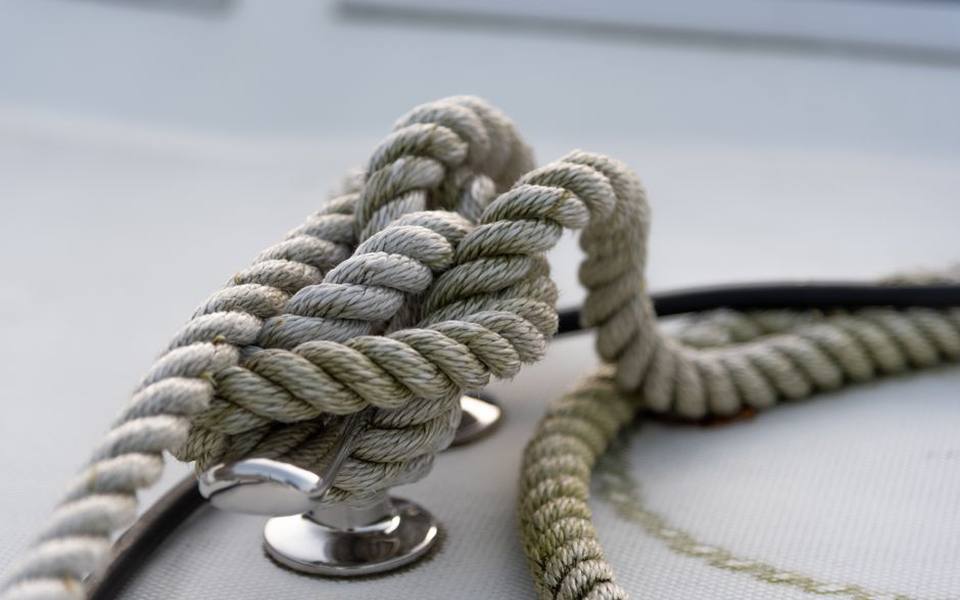
Securing a vessel requires robust tie-down points called mooring cleats, mounted strategically along the forward, spring, and aft positions of the deck. A cleat features a raised anvil shape designed to lock dock lines securely using a traditional cleat hitch knot without jamming under tension. Smaller hardware items include chocks, which guide lines smoothly past the gunwale, and pad eyes, which serve as connection points for fenders or safety tethers.
Quality deck hardware is almost exclusively forged from marine-grade 316 stainless steel, marine-grade aluminum, or bronze to fight off the relentless corrosion of marine environments. Inexpensive fasteners or unbacked cleats can tear clean out of fiberglass when exposed to strong tidal currents. Regular inspection of backing plates and sealant rings ensures that these small exterior fittings never allow rainwater to seep down into hidden structural laminates.
Internal Framing: Bulkheads, Stringers, and the Bilge
Beneath the visible deck cushions and carpet lies the structural skeleton that gives a boat its rigidity and strength. Longitudinal stringers are fiberglass-encased beams that run the length of the hull, bonded directly to the outer skin to prevent the bottom from flexing under wave impacts. Interlocking transverse bulkheads run side-to-side, dividing the hull into distinct compartments and supporting the weight of the upper deck molding.
At the lowest interior point of the hull sits the bilge, a continuous gutter where stray water collects from deck washes, rain, or small leaks. Because water inside the hull lowers stability through the free-surface effect, every boat includes automatic bilge pumps wired directly to the battery. Routine maintenance in the bilge involves checking float switches, clearing debris from pump strainers, and ensuring that through-hull fittings and sea cocks remain fully operational and corrosion-free.
Maintaining structural integrity beneath the floorboards is vital for vessel longevity. If stringers become delaminated or bulkheads crack after rough offshore use, the entire hull can develop dangerous flex, leading to gelcoat spider cracks or misaligned engine shafts. When repairs require major structural laminating or pump overhauls, relying on a certified marine service department ensures repairs meet factory structural safety standards.
Published 2026-09-20 · reviewed with each rebuild, last September 2026.
Find boat dealers near you
The directory lists 7,311 boat dealers by state and city — pick your state or use the “Near me” button in the header.
More guides
-
 Storage
Boat Storage and Slip Costs: Dry Storage, Mooring, and Marina Rates Guide
-
 Money
MoneyHow Much Does a Boat Engine Cost? Complete Marine Motor Pricing Guide
-
 Buying
How Much Does a Pontoon Boat Cost to Buy or Rent?
-
 Service
Cosmetic Maintenance, Surface Repairs, and Deck Restorations: A Practical Marine Guide
-
 Owning
Marine Electrical Systems, Critical Hardware, and Modern Repower Planning
-
 Service
Essential Boat Mechanical Repairs: Managing Cables, Pumps, and Routine Service
-
 Owning
Understanding Your Boat's Plumbing, Fuel Systems, and Ownership Costs
-
 Owning
How to Handle Boat Registration, Title Transfers, and USCG Documentation
-
 Owning
Complete Off-Season Preparation: Storage Steps, Costs, and Protective Canvas
-
 Safety
The Essential Boating Safety Equipment Checklist, Education Guide, and Ownership Budgeting
-
 Money
MoneyUnderstanding Marine Loans: Rates, Terms, and Approval
-
 Buying
Center Console vs. Bowrider Boats: Layouts, Costs, and Finding the Right Fit
-
 Safety
How to Tow a Boat Safely and Maintain Trailer Wheel Bearings
-
 Buying
What Is a Marine Survey and How Much Does It Cost?
-
Buying
Yacht Buying, Chartering, and Brokerage Guide
-
Owning
Boat Trailers, Launching, and Ramp Etiquette Guide
-
Buying
Complete Used Boat Buying Guide: Valuations, Inspection, and Bill of Sale
-
Buying
The Complete Pontoon and Tritoon Guide: Layouts, Brands, and Ownership
-
Buying
Jon Boats and Small Aluminum Fishing Boats: Complete Buyer and Build Guide
-
Buying
Bass Boats and Freshwater Fishing Boats Buyer's Guide
-
Buying
Outboard Motors Guide: Yamaha, Suzuki, Mercury Specs and Used Buying
-
Money
Navigating Boat Loans and Marine Financing: Rates, Loan Terms, and Monthly Payment Realities
-
Owning
Boat Clubs vs. Rentals and Charters: Which Waterway Option Fits You?
-
Service
The Complete Guide to Boat Maintenance, Winter Storage, and Mechanical Repairs
-
 Safety
Boating Safety Courses, Licenses, and Certification Guide
-
Buying
Catamarans Guide: Sailing, Power, Hobie, and Buying Options
-
Owning
Marine Batteries Buyer's Guide: Deep Cycle, Lithium, AGM, and Dual Purpose
-
Buying
Electric Trolling Motors: Complete Guide for Kayaks, Pontoons, and Fishing Boats
-
 Owning
Complete Boat Rental Guide: Destinations, Types, and Rates
-
 Service
Boat Fuel Systems and Injector Care: Tanks, Filters, and Cleaning
-
 Buying
Center Console Boats: Types, Construction, and Buying Guide
-
 Owning
Boat Docks, Lifts, and Flotation Systems: Complete Waterfront Guide
-
 Buying
A Complete Guide to Fishing Boats, Sonar Electronics, and Rod Rigging Systems
-
 Owning
Outboard Motors, Jack Plates, and Marine Propellers: The Complete Rigging Guide
-
 Buying
A Complete Guide to Boat Brands, Marine Brokers, and Finding the Right Dealer
-
 Money
MoneyBoat Insurance, Financing, and Title History Lookup: Complete Guide
-
 Buying
Small Boats, Kayaks, Canoes, and Inflatable Craft: Complete Buyer and Rigging Guide
-
 Owning
Marine Canvas, Bimini Tops, and Boat Covers: Selection and Care Guide
-
 Buying
Complete Guide to Boat Shows: Dates, Tickets, and Top US Events