How twin hulls change stability and handling on the water
A catamaran boat relies on two parallel hulls of equal size separated by a central deck structure, which creates an inherently stable geometry without relying on heavy ballast. In traditional single-hull boats, stability comes from hull shape combined with deep lead or iron keels that resist rolling. A multihull achieves what naval architects call form stability, resisting heeling angles naturally through its wide stance across the water surface. This setup fundamentally alters how the craft moves across waves, eliminating the persistent deep roll familiar to monohull owners.
When traveling in choppy waters or open ocean swells, the dual hulls cut through chop independently rather than displacing water from a single central point. That distinct motion profile means the deck stays much flatter, which substantially reduces crew fatigue and eases movement around the vessel while underway. However, catamarans behave differently in quartering seas, where waves can lift one stern before the other, creating a unique corkscrew motion that takes some acclimation for newcomers.
Under close-quarters maneuvering, catamarans provide an exceptional operational advantage. Because their power plants are mounted far apart in separate hulls, operators can pivot the entire vessel within its own length simply by setting one engine to forward and the other to reverse. This wide lever arm gives twin-engine multihulls responsive handling at slow marina speeds, counterbalancing the drift created by higher topside windage.
Sailing catamarans and modern cruising layouts
The appeal of a cruising sailing catamaran centers on interior volume and level sailing. Long-distance cruisers often prefer multihulls because day-to-day life aboard does not require constantly wedging dishes, personal items, or yourself against steep heel angles. Cooking a warm meal while maintaining offshore speeds feels dramatically safer and less draining when the galley floor sits flat beneath your feet throughout an entire offshore passage.
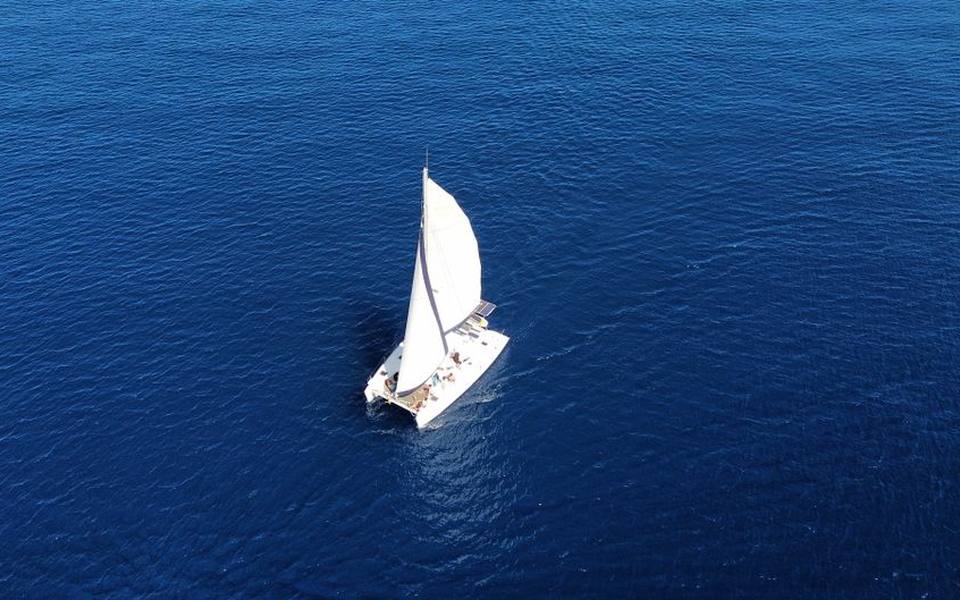
Deck arrangements on a modern catamaran sailboat bridge the interior salon and exterior aft cockpit into a single, seamless living zone. The bridge deck connects the two hulls, sheltering expansive staterooms inside the hull pontoons and providing panoramic views from the central salon windows. Forward, designers typically incorporate flexible lounging trampolines made of woven mesh to keep weight down, or solid forward cockpits that offer deep outdoor seating right behind the forward crossbeam.
Under sail, these craft require a different mindset than traditional ballast-keeled vessels. Because they do not heel over to spill excess wind when gusts strike, structural loads transfer directly into the rig, sails, and crossbeam joints. Cruisers must pay close attention to wind instruments and reef sails early according to manufacturer polars rather than waiting for dramatic deck angles to signal when to reduce sail area.
Beach cats and the legacy of Hobie catamarans
Small multihull sailing was revolutionized decades ago with the introduction of lightweight beach craft, most visibly represented by the iconic Hobie catamaran. These nimble, unballasted twin-hull boats introduced generations of sailors to multihull dynamics through high-speed reaches and agile surf launching. Featuring asymmetrical hulls or simple daggerboards, an accessible beach boat offers exhilarating acceleration without the complexity or storage demands of large cruising vessels.
Rigging and maintaining a smaller hobie cat sailboat remains straightforward compared to keelboats. Most beach models utilize rotomolded polyethylene or durable fiberglass hulls that can be dragged directly onto soft sand without catastrophic gelcoat failure. The rig consists of a rotating mast, a fully battened mainsail, and a simple furling jib, making it possible for a small crew to trailer the boat, step the mast in a parking lot, and launch through ocean surf in under an hour.
Sailing these agile dinghies requires active physical balance and quick reaction times. As speed builds, the windward hull lifts out of the water, dramatically decreasing wetted surface area and propelling the boat forward at remarkable speeds. Crews routinely harness themselves into trapeze gear, suspending their body weight out over the windward pontoon to balance hydrodynamic forces and keep the vessel balanced on its leeward hull.
Understanding the traditional cat boat distinction
In nautical terminology, the phrase cat boat often causes confusion among buyers searching through multihull listings. A true historical catboat is not a twin-hulled multihull at all; rather, it is a traditional single-hulled sailboat characterized by an exceptionally wide beam, a shallow draft with a centerboard, and a single mainsail carried on an unstayed or minimally stayed mast stepped far forward near the bow.
These classic wooden and fiberglass monohulls originated as working fishing and cargo craft in shallow bays throughout the northeastern United States, especially around Cape Cod and Chesapeake Bay. Their broad single hulls provide surprising interior room and rock-solid initial stability for a monohull, but they function on completely different hydrodynamics than a dual-hull catamaran. Buyers scanning marketplaces should examine specification sheets carefully so they do not mistake a vintage single-sail catboat for a modern multihull.
Despite their differences, both hull styles share a common goal of providing stable, functional deck spaces and shallow-water utility. If you are comparing vessels for shallow coastal bays, reviewing the broader selection of boats for sale in stock can clarify whether your intended use calls for the simple sail handling of a classic catboat or the open-water efficiency of a twin-hulled catamaran.
The rise of power cats in fishing and coastal cruising
In recent seasons, power cats have captured a massive share of the recreational boating market, particularly among offshore anglers and family cruisers. Removing the mast and sails allows naval architects to optimize hull lines specifically for engine propulsion. Modern power catamarans typically carry twin or quad outboards mounted on reinforced transom brackets, delivering balanced horsepower, redundant steering, and exceptional reliability in offshore conditions.
Anglers appreciate how a power catamaran eliminates the sharp jarring pounding associated with deep-V monohull center consoles running through steep chop. As the vessel drives through whitecaps, air compresses inside the tunnel between the hulls, creating an aerated cushioning effect that softens impact forces on the hull and lower joints. Furthermore, the square bow and broad foredeck provide vast casting platforms, massive fish boxes, and generous gunwale walkarounds unmatched by tapered monohull bows.
Fuel economy on power multihulls remains competitive because narrow, slender hulls create less skin-friction drag at cruising speeds than a single, wide planning bottom. While pushed through the water, slender pontoons do not generate the large bow waves associated with heavy monohulls. This hydrodynamic efficiency allows boaters to cruise comfortably at respectable speeds while burning manageable quantities of fuel across long offshore distances.
Hull tunnel design, hydrodynamics, and high-speed commercial ferries
The underlying hydrodynamic principles that make twin hulls effective for leisure also govern commercial marine transport. When evaluating advanced hull configurations, naval architects often point to the high speed catamaran ferry designs operating in coastal waterways worldwide. These large vessels utilize wave-piercing bows and mathematically tuned tunnel clearances to transport hundreds of passengers safely through turbulent conditions at speeds exceeding thirty knots.
Tunnel height, often called bridge deck clearance, is the most critical design dimension on any catamaran boat. If the underbody bridge deck sits too close to the waterline, incoming waves slap forcefully against the flat structure beneath the salon or cockpit deck. This slamming creates jarring vibrations, loud impacts, and unwanted structural stress. High-performance passenger vessels and well-engineered leisure cats maintain generous bridge deck clearance to ensure wave crests pass cleanly through the tunnel without impeding hull forward momentum.
Certain modern multihulls also incorporate hydrofoils mounted inside the tunnel between the pontoons. These underwater wings generate vertical lift as boat speed increases, elevating the primary hulls partly or completely out of the water. Foil-assisted power multihulls can achieve remarkable fuel savings and top-end velocities by cutting wetted surface area to a fraction of traditional marine standards.
What to inspect when shopping for a used catamaran
Shopping for a pre-owned multihull requires checking structural components that monohulls simply do not possess. The crossbeams, bulkheads, and bridge deck joints absorb tremendous torsional and flexing forces whenever ocean waves lift the hulls at uneven angles. Anyone exploring a used catamaran for sale should closely examine the joints where bulkheads meet the outer hull skins, looking for cracked tabbing, stress cracks in the gelcoat, or loose structural bonding that indicates excessive flexing under load.
Because weight distribution is paramount on multihulls, buyers must check for unauthorized modifications, heavy aftermarket equipment, or water intrusion in structural cores. Overloaded catamarans suffer degraded bridge deck clearance, lower top speeds, and sluggish buoyancy response in heavy seas. If previous owners installed heavy auxiliary generators or oversized tenders without proper planning, the boat's balance and safety margins may be compromised.
When purchasing from used boat dealers, always demand a professional marine survey performed by a surveyor with multihull accreditation. A qualified surveyor will sound the laminate with a phenolic hammer, check moisture levels around escape hatches and chainplates, inspect rudder posts and bearings inside the narrow engine compartments, and verify that structural stringers remain tightly anchored to the hulls.
Budgeting for slips, haul-outs, and maintenance costs
The generous beam that makes a multihull comfortable at anchor can present significant cost considerations once you return to the marina. In most coastal harbors, dock masters charge slips based on linear foot length, but catamarans often trigger a surcharge of thirty to fifty percent due to their wide footprint. In crowded ports, slips wide enough to fit a multihull can be difficult to locate, requiring owners to secure end-ties or pay for T-head dock spaces.
Routine dry-dock maintenance also involves specialized logistics. Standard marine travel lifts are built to haul typical monohull beam widths, meaning broad multihulls may exceed lift dimensions at conventional yards. Owners must verify that local service facilities operate wide-frame haul-out machines, marine railways, or mobile trailers capable of lifting a twin-hulled craft without pinching or cracking the pontoons during hoisting.
Mechanical maintenance naturally scales with the number of systems on board. Catamarans feature two separate engines, two sets of sail drives or straight shafts, two rudders, and frequently duplicate steering linkages. Working with established boat dealers with a service department ensures that routine bottom painting, drive maintenance, zinc replacement, and seal servicing remain on schedule, preserving the vessel's resale value over time.
Navigating the purchase process and financing twin-hull boats
Evaluating a power catamaran for sale involves practical steps that differ from typical fiberglass monohull transactions. Buyers must assess whether the vessel's draft and width align with local waterways, private docks, and bridge clearances. A detailed sea trial should test the boat in actual ocean chop rather than calm harbor basins, giving you a clear sense of how the tunnel handles chop, how the craft banks in hard turns, and how quiet the hull remains underway.
Financing a multihull follows standard marine lending procedures, but loan underwriting teams look closely at the vessel make, hull valuation, and survey findings. Because multihulls carry high resale value in cruising hubs, many marine lenders readily underwrite qualified buyers through structured loan programs. Exploring options through boat dealers offering financing can help secure competitive loan terms tailored to long-term ownership or extended cruising voyages.
Insurance coverage requires equal care during the closing stages of a purchase. Underwriters frequently evaluate the owner's documented experience operating twin-screw craft or multihulls over a specified length. If transitioning from a smaller monohull to an offshore cruising catamaran, underwriters may mandate that you complete checkout hours with a licensed captain before granting full offshore sailing endorsements.
Trailering, launching, and daily operation tips
Smaller power cats and sport catamarans can be trailered, but doing so requires specialized trailer frames built to support dual pontoons evenly. Catamaran trailers feature widely spaced bunks, heavy-duty guide-on posts, and drop axles that let the hulls sit low between the wheels to stay within highway height restrictions. When approaching a ramp, drivers must ensure sufficient water depth across the entire width of the launch lane so both hulls float free simultaneously.
Handling a twin-engine catamaran around the dock is remarkably intuitive once you embrace throttle-only steering. At low speeds, leave the wheel centered and control directional movement purely through alternating forward and reverse thrust on the twin throttles. Pushing the starboard throttle forward while pulling the port throttle into reverse rotates the bow cleanly to port without demanding excessive boat speed or awkward rudder angles.
Windage remains the primary operational factor when docking or anchoring. Catamarans have shallow drafts and broad hull sides that catch ocean breezes like sails. Operators should plan docking approaches that keep the bow into the wind when possible, prepare spring lines well in advance, and always deploy a dual-bridle setup when setting anchor so the boat rides smoothly through overnight wind shifts.
Published 2026-09-20 · reviewed with each rebuild, last September 2026.
Find boat dealers near you
The directory lists 7,311 boat dealers by state and city — pick your state or use the “Near me” button in the header.
More guides
-
 Storage
Boat Storage and Slip Costs: Dry Storage, Mooring, and Marina Rates Guide
-
 Money
MoneyHow Much Does a Boat Engine Cost? Complete Marine Motor Pricing Guide
-
 Buying
How Much Does a Pontoon Boat Cost to Buy or Rent?
-
 Service
Cosmetic Maintenance, Surface Repairs, and Deck Restorations: A Practical Marine Guide
-
 Owning
Marine Electrical Systems, Critical Hardware, and Modern Repower Planning
-
 Service
Essential Boat Mechanical Repairs: Managing Cables, Pumps, and Routine Service
-
 Owning
Understanding Your Boat's Plumbing, Fuel Systems, and Ownership Costs
-
 Owning
How to Handle Boat Registration, Title Transfers, and USCG Documentation
-
 Owning
Complete Off-Season Preparation: Storage Steps, Costs, and Protective Canvas
-
 Safety
The Essential Boating Safety Equipment Checklist, Education Guide, and Ownership Budgeting
-
 Money
MoneyUnderstanding Marine Loans: Rates, Terms, and Approval
-
 Buying
Center Console vs. Bowrider Boats: Layouts, Costs, and Finding the Right Fit
-
 Safety
How to Tow a Boat Safely and Maintain Trailer Wheel Bearings
-
 Buying
What Is a Marine Survey and How Much Does It Cost?
-
Buying
Yacht Buying, Chartering, and Brokerage Guide
-
Owning
Boat Trailers, Launching, and Ramp Etiquette Guide
-
Buying
Complete Used Boat Buying Guide: Valuations, Inspection, and Bill of Sale
-
Buying
The Complete Pontoon and Tritoon Guide: Layouts, Brands, and Ownership
-
Buying
Jon Boats and Small Aluminum Fishing Boats: Complete Buyer and Build Guide
-
Buying
Bass Boats and Freshwater Fishing Boats Buyer's Guide
-
Buying
Outboard Motors Guide: Yamaha, Suzuki, Mercury Specs and Used Buying
-
Money
Navigating Boat Loans and Marine Financing: Rates, Loan Terms, and Monthly Payment Realities
-
Owning
Boat Clubs vs. Rentals and Charters: Which Waterway Option Fits You?
-
Service
The Complete Guide to Boat Maintenance, Winter Storage, and Mechanical Repairs
-
 Safety
Boating Safety Courses, Licenses, and Certification Guide
-
Owning
Marine Batteries Buyer's Guide: Deep Cycle, Lithium, AGM, and Dual Purpose
-
Buying
Electric Trolling Motors: Complete Guide for Kayaks, Pontoons, and Fishing Boats
-
 Owning
Complete Boat Rental Guide: Destinations, Types, and Rates
-
 Service
Boat Fuel Systems and Injector Care: Tanks, Filters, and Cleaning
-
 Buying
Center Console Boats: Types, Construction, and Buying Guide
-
 Owning
Boat Docks, Lifts, and Flotation Systems: Complete Waterfront Guide
-
 Buying
A Complete Guide to Fishing Boats, Sonar Electronics, and Rod Rigging Systems
-
 Owning
Outboard Motors, Jack Plates, and Marine Propellers: The Complete Rigging Guide
-
 Buying
A Complete Guide to Boat Brands, Marine Brokers, and Finding the Right Dealer
-
 Money
MoneyBoat Insurance, Financing, and Title History Lookup: Complete Guide
-
 Buying
Small Boats, Kayaks, Canoes, and Inflatable Craft: Complete Buyer and Rigging Guide
-
 Owning
Marine Canvas, Bimini Tops, and Boat Covers: Selection and Care Guide
-
 Buying
Complete Guide to Boat Shows: Dates, Tickets, and Top US Events
-
 Owning
Boat Anatomy 101: Hull Parts, Steering Wheels, and Terminology