Choosing Between Floating Docks and Fixed Waterfront Piers
A reliable dock for boats must match both the local shoreline topography and the natural movement of the surrounding body of water. Fixed pier docks stand on driven wooden or concrete pilings and remain at a constant height regardless of changes in water level. They excel in locations with minimal water fluctuation, shallow shorelines, or heavy chop where rigid construction provides superior walking stability. However, when tides or seasonal reservoir drawdowns cause water levels to shift by more than a couple of feet, tied-off lines require constant adjustment to avoid swamping or hanging the vessel.
Modern floating docks solve fluctuating water challenges by rising and falling alongside the surface on integrated guide piles or underwater anchoring cables. Built around heavy-duty polyethylene shells packed with expanded polystyrene foam, these flotation systems maintain a uniform freeboard height between the deck and your boat. Boarding remains effortless and consistent whether the lake is at full pool or drought stage, eliminating tricky climbs over gunwales during low-water periods. They also adapt well to soft, muddy lakebeds where driving rigid pilings proves difficult or economically impractical.
When comparing construction materials for a residential boat dock, durability against rot, sun exposure, and marine borers dictates long-term ownership costs. Pressure-treated southern yellow pine remains an accessible baseline, but it requires periodic sealing and eventually splinters under harsh solar exposure. Aluminum frames paired with marine-grade composite or cellular PVC decking offer a lightweight, splinter-free alternative that resists saltwater corrosion and requires minimal maintenance beyond occasional pressure washing. Your final layout should balance gangway slope, slip width, and local environmental setbacks before any hardware enters the water.
The Practical Advantages of Storing a Boat on a Lift
Keeping a lifted boat suspended out of the water between outings provides immediate protection against the most common causes of long-term hull deterioration. Constant immersion encourages marine organisms, algae, and barnacles to colonize bare gelcoat, significantly increasing hull drag and degrading fuel economy. Over several seasons, water absorption into unsealed fiberglass can trigger osmotic blister formation, an expensive structural issue that demands intensive grinding and barrier coating to remedy.

Mooring a vessel directly in a wet slip also subjects it to continuous wave surge, wake turbulence, and shifting winds that strain dock lines and chafe rubbing strakes. In tidal bays or high-traffic lake channels, loose lines or failing fenders can force a hull repeatedly into rough pilings or concrete seawalls. A properly rated mechanical boat lift secures the vessel entirely above wake action, preventing dock rash, rainwater accumulation in the bilge, and the catastrophic risk of failed thru-hull fittings sinking the craft quietly overnight.
Beyond hull preservation, elevated storage dramatically simplifies routine maintenance, engine flushing, and pre-departure inspections. Owners can walk around the perimeter, scrub scum lines effortlessly, inspect propellers, and cycle running gear without donning a wetsuit or hauling the boat onto a road trailer. Lowering the vessel into the water takes under two minutes with an electric hoist, giving you the immediate convenience of a wet slip combined with the protective security of indoor dry rack storage.
Cradle Lifts and Overhead Hoist Systems
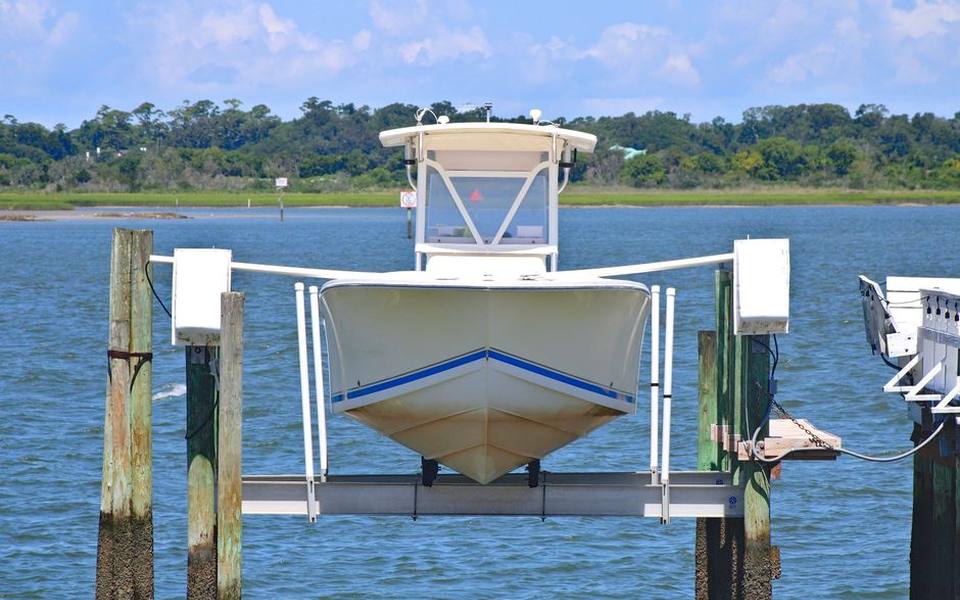
The standard four-post or eight-post boat lift is the backbone of waterfront residential docking, relying on vertical structural pilings driven directly into the lakebed or seabed. A synchronized electric motor turns drive pipes fitted with grooved cable winders, winding high-tensile stainless steel aircraft cables that raise and lower a submerged steel or aluminum cradle. When lowered, the vessel floats freely into the slip; when engaged, the bunked cradle lifts the hull clear of the waterline and holds it in stable equilibrium.
An overhead boat hoist lift configuration places the drive shafts, gearboxes, and electric motors high atop structural crossbeams, safely isolated from corrosive salt spray and storm surges. This overhead design makes visual cable inspection straightforward and keeps grease fittings accessible from the dock walkway. Dual-motor systems with electronic leveling sensors help prevent uneven lifting when hull weight is distributed asymmetrically due to heavy four-stroke outboards, full fuel tanks, or onboard freshwater reservoirs positioned toward the stern.
Selecting the correct hoist capacity requires calculating the true wet weight of your vessel rather than relying strictly on manufacturer dry specifications. Fuel adds roughly six pounds per gallon, water adds over eight pounds per gallon, and onboard safety gear, anchors, coolers, and wakeboard towers add substantial bulk. Marine contractors generally recommend choosing a lift rated for at least twenty to twenty-five percent above your total calculated wet weight to avoid overloading gear assemblies and straining structural pilings.
Boat Elevator Lifts for Narrow Canals and Seawalls
In tight residential canals, dredged lagoons, and narrow waterways, local zoning codes often restrict how far pilings may extend outward from the shoreline. A boat elevator provides an engineered solution for waterfronts where driving outer pilings would block navigable channels or violate municipal navigational setbacks. Instead of relying on a four-corner post perimeter, elevator lifts mount directly to a concrete seawall, rock bulkhead, or a single row of reinforced shoreward pilings.
The lifting carriage of an elevator lift rides along heavy structural aluminum or stainless steel I-beams driven into the seabed at an angle, typically between ten and twenty degrees. The submerged tracks guide the bunked cradle downward into deep water to receive the boat and pull it upward and inward toward the bulkhead when raised. Because the entire load cantilevers off the shoreward structure, the mounting seawall or piling foundation must possess adequate reinforcement to withstand substantial rotational and vertical torque forces.
Elevator systems require vigilant maintenance because their drive tracks, guide rollers, and lower carriage assemblies remain continuously submerged or cycle through the active splash zone. Sacrificial zinc or aluminum anodes are mandatory on all underwater metal components to combat galvanic corrosion, especially in brackish coastal waters. Routine lubrication of carriage rollers and periodic flushing of track channels with fresh water keep the carriage gliding smoothly along the angled beams without binding.
Configuring Bunks for Pontoon and Multi-Hull Vessels
Standard V-hull lift bunks fail to support multi-tube pontoon boats properly, as concentrated point loads on thin aluminum tubes can cause denting, structural buckling, and weld seam leaks. Waterfront owners docking multi-tube craft should seek advice from pontoon and tritoon boats specialists to install bunking kits that distribute weight evenly along the full length of each individual tube. Custom-molded vinyl or carpeted lumber bunks must cradle outer tubes securely while clearing center underskinning shields and lifting strakes.
Triple-tube performance pontoons present distinct lifting challenges due to the added mass of large center tubes and high-horsepower outboard engines mounted on transom pods. Three-bunk cradle conversions feature independent center bunks positioned lower than outer rails to accommodate the drop-down deadrise of performance hulls. Ensuring proper bunk spacing prevents running gear, transducer brackets, and bottom drain plugs from hanging up on the structural crossmembers during launch or retrieval cycles.
Some owners utilize under-deck pontoon lifts, which lift the boat by structural crossbeams beneath the floor deck rather than supporting the aluminum pontoons from below. While under-deck lifting eliminates bunk alignment issues in shallow water, it requires precise centering to prevent twisting deck fasteners or warping chassis brackets. Most marine contractors now favor full-length bottom cradle bunks because they distribute the engine and passenger load across the pontoon structure exactly as the open water does.
Drive-On Ports and Lifts for Personal Watercraft
Personal watercraft require dedicated dry storage systems that allow quick, convenient launching without the mechanical complexity of full-size boat lifts. A modular jet ski floating dock utilizes high-density polyethylene pontoons with an integrated entry ramp and internal poly-rollers. The operator simply approaches at idle speed and applies a brief blip of throttle to glide the ski up out of the water, resting the craft safely on non-marring bunks above the waterline.
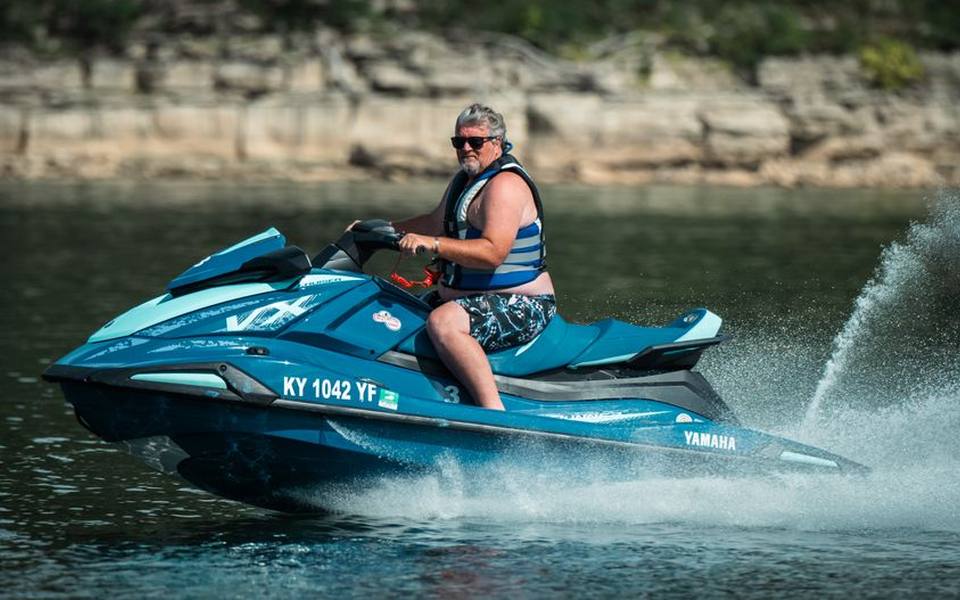
For shallow bays, fluctuating rivers, and rougher coastal waters, a mechanical jet ski lift installed on a dock piling or seawall provides superior security against high wakes. These single-mast mechanical hoists feature compact manual winches or fractional-horsepower electric motors that swing the watercraft completely over the dock walkway for servicing, cleaning, or refueling. Mechanical hoists also eliminate the bottom-scouring issues that can occur when driving onto floating ramps in low-tide conditions.
Dual-ski docks and linked floating waverunner dock platforms allow multiple watercraft to sit side by side along a single dock footprint, maximizing shoreline efficiency. These modular units attach securely to existing floating docks via flexible hinge kits or slide vertically along fixed pilings using galvanized pipe brackets. Because they require no electrical wiring, underwater cables, or hydraulic fluid, drive-on flotation ports represent an economical and practically maintenance-free dry dock solution for personal watercraft.
Essential Dock Accessories and Safe Boarding Hardware
A safe, functional dock requires thoughtful outfitting beyond the primary framing and flotation to ensure effortless boarding and structural protection. Heavy-duty dock ladders are critical safety features, providing swimmers and fallen boaters an immediate path out of deep water. Retractable or flip-up ladder designs are preferable over stationary models because keeping the lower aluminum or stainless steel rungs out of the water when not in use prevents slick algae buildup and barnacle colonization.
Mooring hardware must be sized appropriately for your vessel's displacement and through-bolted with heavy backing plates rather than secured with light wood screws. Cast aluminum or marine-grade stainless steel S-cleats placed every ten to twelve feet offer dependable tie-off points for spring lines and temporary dockage. Heavy-duty vertical bumpers and corner dock wheels protect hull rub rails during windy approaches, absorbing impact energy before hard fiberglass contacts structural framing.
Adequate dock lighting, shore power pedestals, and freshwater washdown spigots transform an ordinary slip into a functional home base for evening cruising and routine washdowns. Low-voltage solar or LED perimeter lighting illuminates walking surfaces, transition gangways, and lift controls without blinding night-adapted vision during late-docking maneuvers. Clean cable routing through protective PVC conduits prevents tripping hazards and shields electrical wiring from corrosive damp environments.
Winter Care, Ice Protection, and Seasonal Removal
In northern climates where freshwater lakes freeze over winter, ice expansion can crush floating dock floats, shift driven pilings, and tear mechanical lift cradles apart. Waterfront homeowners must coordinate seasonal haul-out routines alongside standard winterization and off-season storage procedures before the first hard freeze locks the basin. Sectional aluminum docks and lightweight pipe-supported lifts are typically removed from the water using wheeled axle kits and staged safely on high ground.
For permanent pilings and heavy cradle lifts that cannot be practically hauled ashore each autumn, submerged de-icing systems provide vital structural protection. Continuous aeration lines or submersible propeller-driven circulators pull warmer, denser water upward from the lake floor toward the surface. This steady water movement maintains an open ring of liquid water around wooden pilings and lift legs, preventing expanding sheet ice from grabbing posts and jacking them out of the bottom sediment during freeze-thaw cycles.
Owners of floating docks in cold regions must follow manufacturer protocols regarding seasonal storage or repositioning. Some modular polyethylene docks are rated to freeze in place provided they are unpinned from rigid shoreline abutments and allowed to shift naturally with surface ice sheets. However, if moving river ice or heavy shifting floes threaten the cove, relocating docks to sheltered bays or choosing indoor on-site boat storage facilities for your vessel prevents catastrophic structural loss during harsh winter months.
Routine Cable, Motor, and Hardware Maintenance
Mechanical boat lifts depend on high-tensile stainless steel or galvanized cables that endure significant cyclic loading every time the vessel is hoisted. Over time, friction and bending over pulleys cause interior wire strands to fatigue, fray, and snap, a process known as cable blooming or birdcaging. Lift cables should undergo visual and tactile inspection at least twice a year; any kinked, flattened, or frayed cable must be replaced immediately to avert sudden catastrophic failure.
Drive gearboxes, grease fittings, and hoist motor brakes require continuous lubrication and inspection to maintain smooth lifting torque and prevent slipping. Sealed direct-drive planetary gear systems generally need less routine upkeep than traditional open-belt flat-plate pulleys, but both designs require regular lubrication at all grease zerks. When sourcing replacement pulleys, limit switches, or bunk carpeting, contacting a well-stocked marine parts counter ensures you receive marine-grade components rated to handle moist, corrosive environments.
Cradle bunks, mounting brackets, and underwater fasteners should be checked annually for loose bolts, galvanic electrolysis, and carpet wear. Worn bunk carpeting allows exposed mounting bolt heads to gouge fiberglass gelcoat or aluminum hull plating during rough docking approaches. Replacing degraded timber bunks with synthetic composite bunks or heavy-duty grooved aluminum extrusions eliminates rot concerns and provides a slick, non-marring surface that facilitates smooth vessel centering.
Permits, Structural Engineering, and Contractor Selection
Constructing a private boat dock or installing a permanent boat lift is tightly regulated across most freshwater lakes, coastal sounds, and tidal estuaries. Waterfront projects typically require approval from municipal zoning boards, state departments of natural resources, and the U.S. Army Corps of Engineers. Permitting agencies assess your proposed structure's impact on shoreline riparian rights, submerged aquatic vegetation, watercraft navigational channels, and neighbor property boundary line setbacks.
Hiring a licensed, insured marine contractor who specializes in local shoreline conditions is the most dependable way to navigate permitting hurdles and soil engineering. Pile driving depths depend heavily on bottom sediment composition; loose sand, silt, and fractured rock demand distinct piling diameters, penetration depths, and driving equipment. A qualified marine contractor will calculate prevailing wind exposure, tidal ranges, and fetch length to design an anchor and piling plan that withstands severe coastal squalls.
Before signing construction contracts or purchasing lift machinery, verify that your marine contractor carries specialized USL&H (United States Longshore and Harbor Workers' Compensation) marine liability insurance. Partnering with a reputable installer or consulting a qualified boat service center helps coordinate dock bunk dimensions directly with your boat's hull deadrise, ensuring your waterfront slip delivers reliable, turn-key convenience for years of trouble-free boating.
Published 2026-09-20 · reviewed with each rebuild, last September 2026.
Find boat dealers near you
The directory lists 7,311 boat dealers by state and city — pick your state or use the “Near me” button in the header.
More guides
-
 Storage
Boat Storage and Slip Costs: Dry Storage, Mooring, and Marina Rates Guide
-
 Money
MoneyHow Much Does a Boat Engine Cost? Complete Marine Motor Pricing Guide
-
 Buying
How Much Does a Pontoon Boat Cost to Buy or Rent?
-
 Service
Cosmetic Maintenance, Surface Repairs, and Deck Restorations: A Practical Marine Guide
-
 Owning
Marine Electrical Systems, Critical Hardware, and Modern Repower Planning
-
 Service
Essential Boat Mechanical Repairs: Managing Cables, Pumps, and Routine Service
-
 Owning
Understanding Your Boat's Plumbing, Fuel Systems, and Ownership Costs
-
 Owning
How to Handle Boat Registration, Title Transfers, and USCG Documentation
-
 Owning
Complete Off-Season Preparation: Storage Steps, Costs, and Protective Canvas
-
 Safety
The Essential Boating Safety Equipment Checklist, Education Guide, and Ownership Budgeting
-
 Money
MoneyUnderstanding Marine Loans: Rates, Terms, and Approval
-
 Buying
Center Console vs. Bowrider Boats: Layouts, Costs, and Finding the Right Fit
-
 Safety
How to Tow a Boat Safely and Maintain Trailer Wheel Bearings
-
 Buying
What Is a Marine Survey and How Much Does It Cost?
-
Buying
Yacht Buying, Chartering, and Brokerage Guide
-
Owning
Boat Trailers, Launching, and Ramp Etiquette Guide
-
Buying
Complete Used Boat Buying Guide: Valuations, Inspection, and Bill of Sale
-
Buying
The Complete Pontoon and Tritoon Guide: Layouts, Brands, and Ownership
-
Buying
Jon Boats and Small Aluminum Fishing Boats: Complete Buyer and Build Guide
-
Buying
Bass Boats and Freshwater Fishing Boats Buyer's Guide
-
Buying
Outboard Motors Guide: Yamaha, Suzuki, Mercury Specs and Used Buying
-
Money
Navigating Boat Loans and Marine Financing: Rates, Loan Terms, and Monthly Payment Realities
-
Owning
Boat Clubs vs. Rentals and Charters: Which Waterway Option Fits You?
-
Service
The Complete Guide to Boat Maintenance, Winter Storage, and Mechanical Repairs
-
 Safety
Boating Safety Courses, Licenses, and Certification Guide
-
Buying
Catamarans Guide: Sailing, Power, Hobie, and Buying Options
-
Owning
Marine Batteries Buyer's Guide: Deep Cycle, Lithium, AGM, and Dual Purpose
-
Buying
Electric Trolling Motors: Complete Guide for Kayaks, Pontoons, and Fishing Boats
-
 Owning
Complete Boat Rental Guide: Destinations, Types, and Rates
-
 Service
Boat Fuel Systems and Injector Care: Tanks, Filters, and Cleaning
-
 Buying
Center Console Boats: Types, Construction, and Buying Guide
-
 Buying
A Complete Guide to Fishing Boats, Sonar Electronics, and Rod Rigging Systems
-
 Owning
Outboard Motors, Jack Plates, and Marine Propellers: The Complete Rigging Guide
-
 Buying
A Complete Guide to Boat Brands, Marine Brokers, and Finding the Right Dealer
-
 Money
MoneyBoat Insurance, Financing, and Title History Lookup: Complete Guide
-
 Buying
Small Boats, Kayaks, Canoes, and Inflatable Craft: Complete Buyer and Rigging Guide
-
 Owning
Marine Canvas, Bimini Tops, and Boat Covers: Selection and Care Guide
-
 Buying
Complete Guide to Boat Shows: Dates, Tickets, and Top US Events
-
 Owning
Boat Anatomy 101: Hull Parts, Steering Wheels, and Terminology